
Traffic Warrants in Putnam County
A traffic citation in Indiana starts a court case with a deadline attached. You must answer it, pay it when the court permits, or show up on the assigned date. Miss that setting and traffic procedure lets the court issue a warrant for failure to appear, plus report the miss to the Bureau of Motor Vehicles. Putnam County sends its traffic infractions to the county Magistrate Court. The court file is the core public record here. A police list will not carry it, and a driver-history product will not settle it. Putnam County also publishes no traffic-warrant roster, no city citation portal, and no separate municipal-court warrant database. Instead, the county's official traffic page tells you to call the Circuit Court Clerk for the case number before using PayGov. That local instruction sets a safe order of steps. Identify the case first. Read its docket. Talk with the court. Only then take the approved payment or appearance step.
Putnam Traffic Warrants Follow Citations
The local chain is direct but each step must be verified: citation or traffic information and summons → court filing and deadline → payment or appearance → failure-to-appear entry when the duty is missed → possible warrant and BMV report → court-approved remedy → updated court and BMV status. The docket can contain several of these events, so an old warrant line should never be read without checking what came later.
Indiana paperwork speaks of arrest warrant, bench warrant, and failure to appear. Putnam County does not use "capias pro fine" as a controlling term, so drop that phrase when you call. Repeat the exact wording from your case summary to the Clerk or Magistrate Court. That one habit tells staff fast whether you face a citation balance, a required hearing, a warrant order, a bond term, or a later recall.
- FTA
- Failure to appear or answer as the court required.
- Recall
- A court order withdrawing a warrant.
- Disposition
- The court’s resolution of the citation or case.
- BMV report
- A court notice that may affect driving privileges under Indiana law.
How to Check for a Putnam County Traffic Warrant
No single screen settles a Putnam County traffic-warrant question, so work each channel. Begin with Indiana MyCase, which finds a public case by citation number, case number, or party name. A warrant event may show in the case summary. The state warrant FAQ warns that MyCase is not a warrant search.
- Search MyCase by the citation number or by last name with another allowed identifier. Select the Putnam court where useful and review All status.
- Call the Putnam Circuit Court Clerk at 765-653-2648. Ask for the cause number and assigned court rather than assuming the citation remains only with a police agency.
- Call Putnam Magistrate Court at 765-301-9197 when the docket concerns a traffic infraction or ordinance matter. Ask whether an FTA or warrant is active.
- If a public document is needed, request it from the Clerk. For law-enforcement service records, contact the agency that holds them.
- Speak with counsel when arrest, bond, a contested charge, or the right court filing is unclear.
The Putnam County Courthouse in Greencastle houses the courtrooms, and you can appear there in person. The county publishes no warrant counter, walk-in calendar, identification rule, or special warrant hours. So call before you drive over.
Putnam Magistrate Handles Traffic Cases
Traffic infractions and ordinance violations both appear on the official Putnam Magistrate Court page. For a Putnam County ticket, that page is the clearest sign of where the case lands.
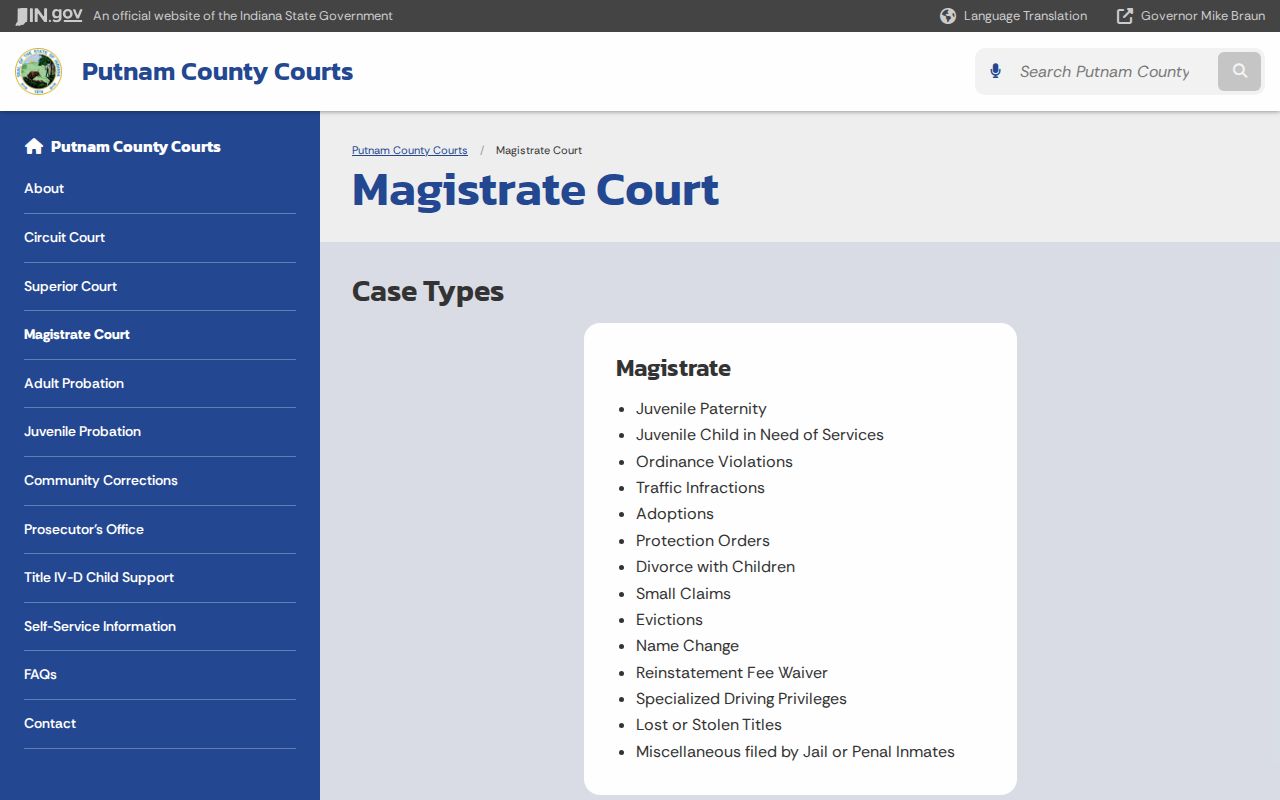
Magistrate routing does not mean every city citation ends in a warrant, so search the individual cause and confirm it. A matter with a different criminal classification or assignment may land in Circuit or Superior Court instead. All three Putnam County courts sit in the same courthouse. Reach Magistrate Court at 765-301-9197. The Clerk answers at 765-653-2648. Staff can give factual case information, hearing dates, and procedural instructions. They will not interpret an order, pick a strategy, or advise a plea.
What a Traffic Warrant Shows
Expect the public case record to show the citation and later court events rather than a stand-alone warrant document. Putnam County publishes no live sample, so rely on the identifiers the county and MyCase actually support. Do not guess at warrant-number patterns or status labels the court never used.
| Case number | The court cause used for Clerk, MyCase, and payment routing; display may resemble 67H01 as a court-code segment, but use the actual assigned number. |
|---|---|
| Citation number | The number printed on the ticket and accepted as a MyCase search option when entered in the required form. |
| Party | The person named in the court case; name searches may be narrowed with permitted fields. |
| Issuing court | The assigned Putnam court, commonly Magistrate for traffic infractions. |
| Chronological events | Filing, hearing, FTA, warrant, bond, payment, recall, or disposition entries. |
| Amount or bond | Only the amount the current court record or staff confirms. |
| Status | Open or closed case status does not by itself prove whether a warrant is active. |
Read the event sequence closely. Call with both the citation and cause number in hand. A paid balance, a closed label, or an old warrant entry in Putnam County can all mislead you without the court's current confirmation.
Putnam Case Number Comes First
The official Putnam traffic-payment page tells users to call the Clerk for a case number first, and the county instruction appears right on that page.
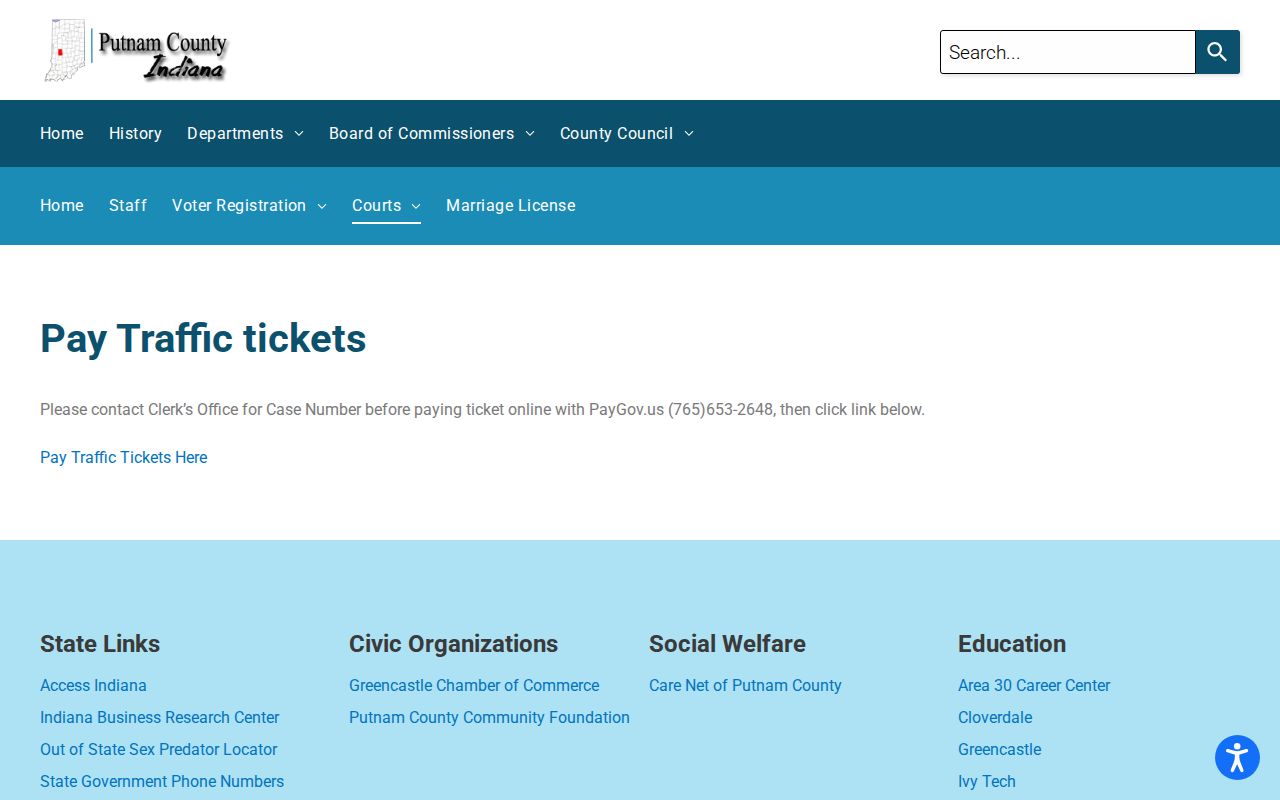
That order of steps protects you from paying against the wrong record. It also gives you the chance to ask whether the case needs more than money. A new date, personal appearance, bond, or judicial recall may be required. The county page links to PayGov as its vendor. It says nothing about payment removing a warrant or releasing a BMV consequence. Putnam County posts no per-charge fee, payment-plan rule, reinstatement time, or warrant-specific payment method. Bring those questions to the Clerk and Magistrate Court.
Paying or Lifting a Traffic Warrant
The issuing court controls a Putnam traffic warrant. Full payment may satisfy it. The court may instead want an appearance, an approved payment plan, bond, a new date, or another judicial step. A vendor payment covers only what the court made payable. It never replaces an order to appear.
- Call the Clerk for the correct cause number and current balance.
- Ask Magistrate Court whether an FTA or warrant exists and what action the judge requires.
- Use PayGov only if court staff confirms online payment is the right route for that case.
- If appearance or bond is required, follow the court’s instructions and ask counsel about the legal options.
- Save the receipt and new hearing notice, then ask when the docket and any BMV report will update.
- Recheck with the Clerk. Do not rely on the receipt alone as proof of warrant recall.
Warning: A payment does not prove recall. Confirm the warrant and any BMV report directly with the issuing Putnam court.
PayGov Is Not Warrant Clearance
The county-approved route sends you to PayGov only after the Clerk supplies the case number. That vendor page is a payment interface, not a court-status search.
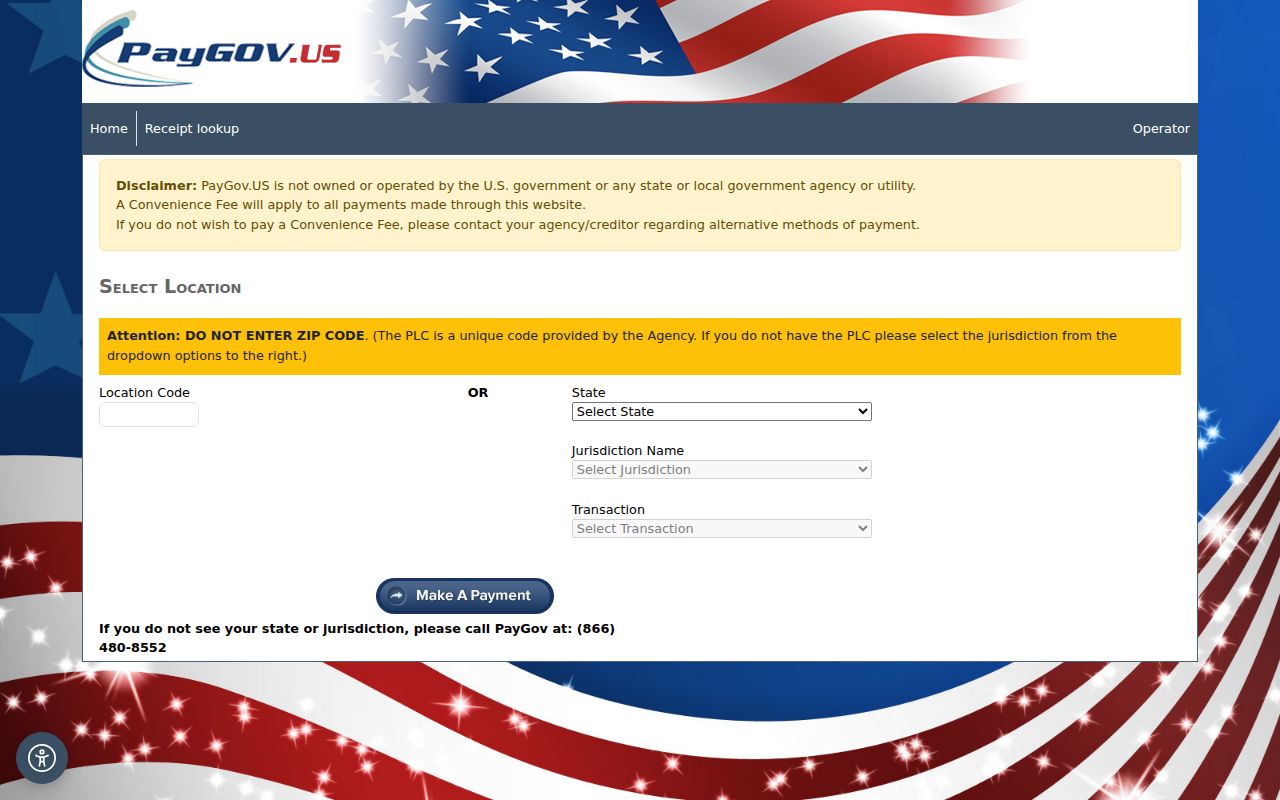
A successful transaction gives you proof of payment, nothing more. It cannot decide whether a judge must recall a warrant, set a hearing, approve a plan, or notify the BMV. Keep the receipt. Then confirm each required action with the court. If the case number is unknown, stop before you pay. A name, citation, or old notice can point to more than one matter. The Clerk supplies the cause-number route in Putnam County, and Magistrate Court states what its current order demands.
Traffic Warrant vs FTA and License Holds
Miss one traffic duty in Putnam County and three separate problems can follow. The warrant itself is what authorizes an arrest. The FTA is the failure to appear the court records on its docket. And the BMV hold is an administrative response to what the court reports. Fixing one does not clear the rest, so check each with the Putnam County court that handled the case.
| Mechanism | Trigger | Effect |
|---|---|---|
| Traffic warrant | Court finds a lawful basis after failure to answer or appear | Authorizes arrest and return to court |
| Failure to appear | Required traffic response or setting is missed | Creates a docket event and may lead to warrant or bond action |
| BMV consequence | Court reports the unresolved FTA under Indiana procedure | May suspend driving privileges until appearance, disposition, payment, or the statutory limit |
Indiana Code 9-30-3-8 covers both the possible warrant and the report to the BMV. The fix has to happen in the court case itself. Putnam County drivers do not settle a traffic warrant by ordering a driving record or reading one.
Putnam Traffic Record Requests
If MyCase lacks the document you need, follow the Indiana court-record request guidance. That official page explains which records sit with the courts and which sit with law enforcement in Putnam County.
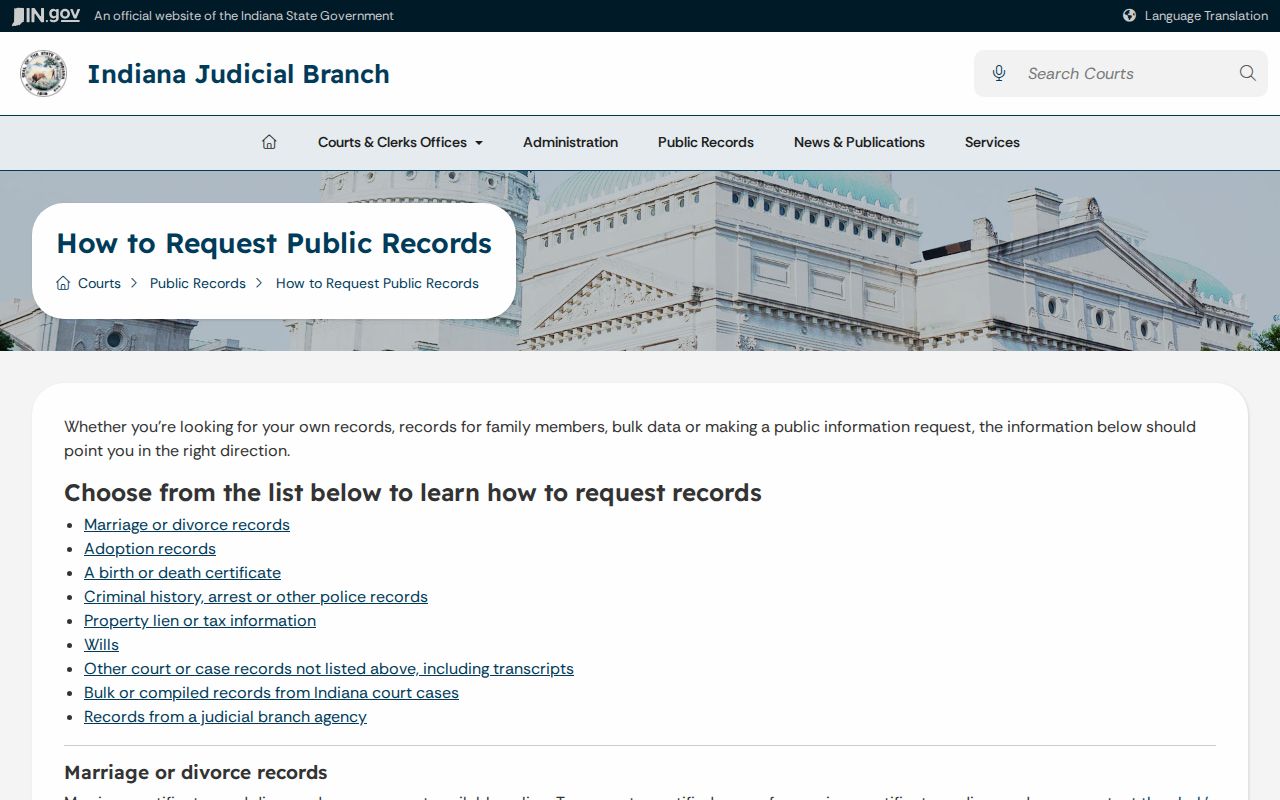
Route each Putnam County request to the right office. Court filings and docket entries go to the Putnam Circuit Court Clerk; arrest and officer-service records go to the law-enforcement agency that holds them. The county offers no warrant-request portal and no traffic-warrant form, so a written request is the path. Keep it narrow: give your contact information, the cause or citation number, a date range, the record type, and how you want delivery. Ask about lawful copy fees up front. Viewing a file is not the same as getting a certified copy, and sealed, expunged, juvenile, or otherwise protected material can stay off limits. After the court grants any remedy, get the filed recall order, your receipt, and the next hearing date in hand. A later traffic stop can surface a warrant that was never fully resolved. Final confirmation belongs with the Clerk or the issuing court, never an unofficial lookup or payment screen.